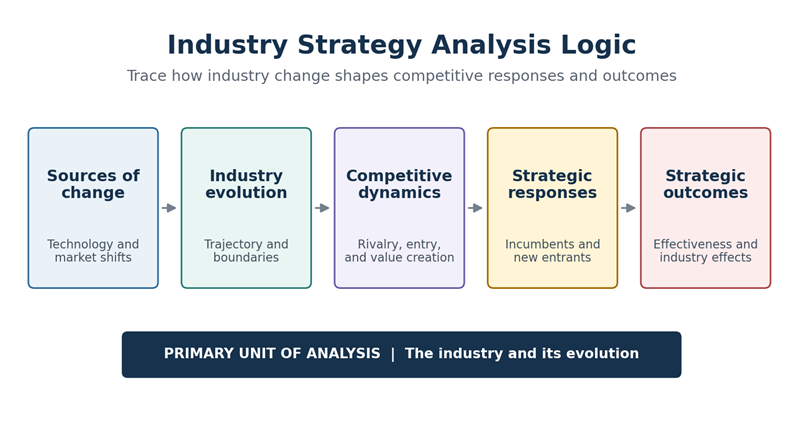

Asia University's PhD Seminar on Industrial Strategy and Development develops students' ability to explain how industries evolve and how firms respond to changing competitive conditions. The industry, rather than the individual firm alone, is the principal unit of analysis. This distinction separates the seminar from a general strategic management course. Students examine how development trajectories, competitive structures, technological change, and strategic choices interact over time. The objective is to develop strategic analysis from a macro perspective, grounded in theory, comparison, and evidence.
The seminar begins with theories of industry evolution and competitive strategy. Students examine how industries emerge, mature, decline, or undergo reconfiguration. They also consider how industry boundaries, patterns of rivalry, entry conditions, and sources of value change during these transitions. Theories are not treated as labels applied after a case is described. Students identify the mechanisms and assumptions behind each explanation and assess whether the evidence supports them. This approach helps students distinguish a persuasive account of industry change from a chronological summary of events.
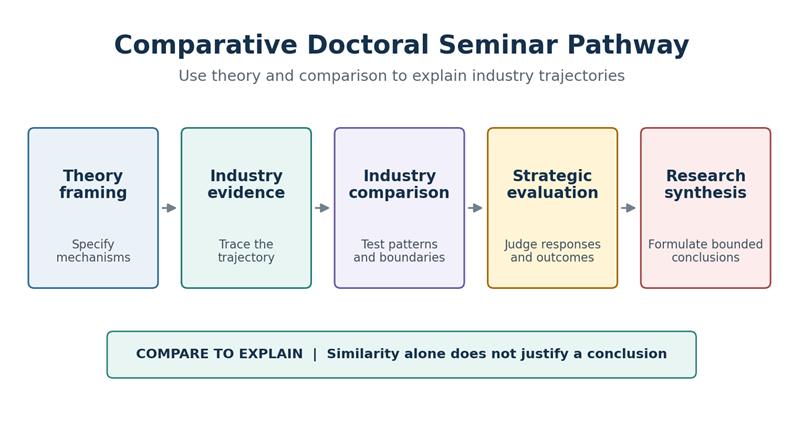
Comparative analysis is a central mechanism of the course. Using a common analytical sequence, students trace development trajectories across different industries and periods. They compare the timing and interaction of technological, market, and competitive changes, then determine which patterns apply across settings and which remain specific to one industry. Comparisons must be justified by relevant dimensions rather than surface similarity. This discipline reduces loose analogies and helps students formulate clearer boundary conditions for claims about industrial development.
Technological change is examined as a force whose strategic consequences must be demonstrated rather than assumed. Students analyze how a technology may alter cost structures, industry boundaries, value networks, entry barriers, customer expectations, or the distribution of bargaining power. They then infer possible industry trends while separating observed evidence from speculation. Contemporary examples may include digital platforms, artificial intelligence, smart manufacturing, energy transition, and supply chain reconfiguration. The emphasis remains on explaining how and under what conditions a technological change reshapes competition.
The course connects industry change to strategic responses by incumbents, new entrants, and other participants. Students compare alternative responses and evaluate their outcomes against stated objectives and available evidence. A successful firm case is not accepted as proof of a universally effective strategy. The analysis considers timing, industry conditions, rival actions, and unintended consequences when judging effectiveness. This strengthens students' ability to explain why similar strategies may produce different outcomes across industries or stages of development.
The doctoral seminar uses structured article critique, discussions led by students, comparative cases, and iterative presentation of industry analysis. Students synthesize theory and evidence to explain an industry trajectory, identify forces that reshaped competition, compare strategic responses, and draw bounded conclusions. Peer questioning requires assumptions, comparisons, and trend claims to be defended. By the end of the course, students should be able to evaluate corporate strategy within its industry context, infer trends without overclaiming, and formulate researchable questions on industrial strategy and development.