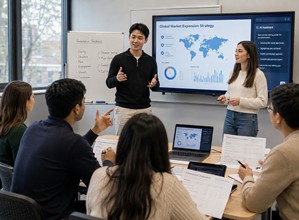

As international business becomes increasingly digital, multilingual, and AI-supported, effective communication now requires more than traditional speaking and presentation skills. Asia University’s Department of Business Administration therefore integrates generative artificial intelligence throughout the required third-year course International Business Communication. The course keeps business communication as its professional foundation while using AI intensively as a practical partner for planning, creating, practicing, evaluating, and improving communication. The goal is not to let AI communicate for students, but to train students to communicate better with AI while maintaining human judgment, credibility, cultural awareness, and personal delivery.
The course follows a learning-by-doing approach. Students develop business presentations, short speeches, professional messages, visual materials, and interactive communication tasks. At the planning stage, they use generative AI to brainstorm topics, analyze audiences, clarify purposes, organize ideas, create outlines, and compare alternative ways to present the same message. Students also practice prompt design so they can give AI clearer instructions and obtain more useful, audience-specific results. AI is used to help students adjust the level, tone, and complexity of English for different audiences. This is especially useful in an international classroom because students can compare formal and conversational wording, identify unclear expressions, and revise their own language rather than simply memorizing a model answer.
AI is also embedded in presentation development. Students learn how to prompt AI to generate possible openings, transitions, examples, questions, conclusions, and audience-engagement strategies. They then evaluate those suggestions and decide what fits their own purpose and speaking style. For visual communication, students can use AI to generate or refine ideas for slide structure, visual hierarchy, images, diagrams, and other presentation materials. Rather than accepting automatically generated content, students are required to simplify, select, verify, and redesign it so that the final presentation remains clear, accurate, audience-centered, and visually effective.
A major feature of the course is the use of AI during rehearsal and improvement. Students can ask AI to convert difficult written material into more natural spoken English, suggest non-verbal delivery cues, generate likely audience questions, and provide alternative responses for Q&A practice. AI-supported translation and pronunciation tools can also help students prepare for multilingual or cross-cultural business situations. These activities allow students to practice repeatedly before presenting in class and to identify weaknesses in clarity, organization, wording, timing, and audience connection. The classroom presentation then becomes the place where students demonstrate what AI cannot replace: confidence, eye contact, vocal variety, body language, spontaneity, credibility, and genuine human connection.
The course also emphasizes critical AI literacy. Students are taught that fluent AI output is not automatically correct or appropriate. They must check facts, sources, numbers, cultural assumptions, and potentially biased or misleading content before using it. They also learn to recognize the risks of overdependence on AI, including generic language, loss of personal voice, inaccurate information, and presentations that look polished but lack understanding. Through comparison, verification, revision, and reflection, students practice a human-AI collaboration cycle in which the student remains responsible for the final decision and final message.
Throughout the semester, AI is therefore not limited to one isolated lesson. It is integrated into multiple stages of communication assignments: topic selection, audience analysis, research support, message organization, language improvement, slide and AI-generated image development, rehearsal, delivery preparation, Q&A simulation, and post-presentation reflection. Students are encouraged to document how they used AI, what they accepted or rejected, and how their own judgment improved the final result. This makes AI use visible as part of the learning process rather than as a shortcut for producing finished work.
The course culminates in increasingly independent presentations and communication tasks in which students combine international business communication principles with responsible AI use. Students are expected to demonstrate not only stronger English and presentation competence, but also the ability to work productively with AI while preserving originality, ethical responsibility, and professional judgment. By embedding AI in authentic communication practice, the course prepares students for a workplace in which professionals will increasingly be expected to collaborate with intelligent tools while still providing the human qualities that technology cannot replace.