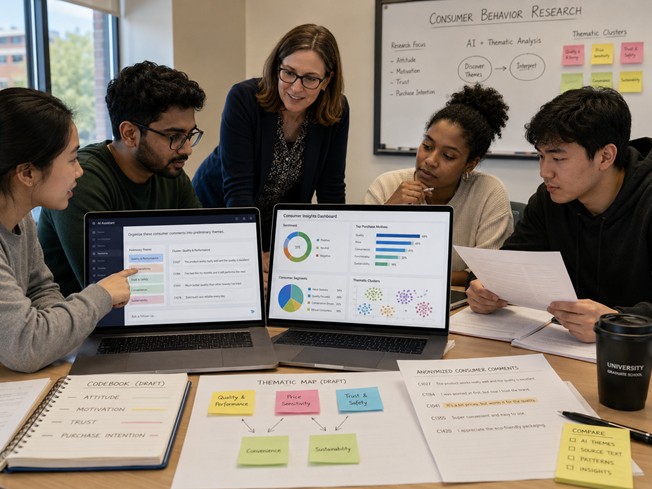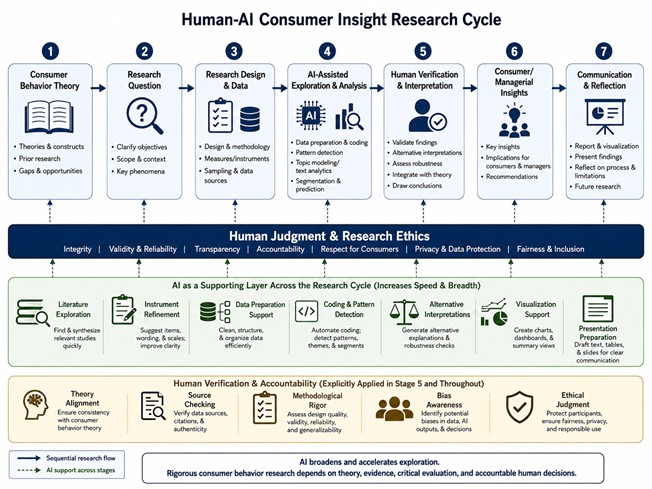

Consumer behavior research is increasingly shaped by large volumes of digital information, rapidly changing markets, and new AI-supported methods for exploring how consumers think, feel, choose, and respond. Asia University’s Department of Business Administration therefore integrates generative artificial intelligence throughout the graduate elective course Consumer Behavior Research. The course retains consumer behavior theory and research methodology as its academic foundation, while using AI intensively as a research partner for exploring literature, developing research questions, designing studies, examining consumer data, generating alternative interpretations, and communicating findings. The objective is not to replace scholarly reasoning with AI output, but to help graduate students become more capable researchers who know how to use AI critically, efficiently, and responsibly.
The course begins with the theoretical foundations of consumer behavior, including consumer decision processes, motivation, perception, attitudes, learning, social influence, culture, identity, and post-purchase behavior. AI is introduced as a tool for connecting these theories to contemporary consumer situations. Students can use generative AI to compare theoretical explanations, create contrasting consumer scenarios, identify possible boundary conditions, and explore how the same behavioral phenomenon may appear across products, cultures, demographic groups, or digital environments. These activities help students move beyond memorizing theories and toward using theory as an analytical lens. Students are required to evaluate AI-generated explanations against course concepts and scholarly sources rather than accepting fluent responses as evidence.
AI is also integrated into the early stages of research development. Students use AI-assisted search and summarization as a starting point for exploring research topics, identifying recurring themes, clarifying terminology, and mapping relationships among constructs. They can ask AI to propose competing research questions, alternative conceptual models, or possible hypotheses and then critically assess which suggestions are theoretically defensible. In this process, students learn an important distinction between idea generation and academic justification: AI may help expand the range of possibilities, but the student must verify the literature, locate credible sources, determine whether a relationship is theoretically meaningful, and make the final scholarly judgment.
During research design, students use AI to support questionnaire development, interview planning, scenario construction, and experimental thinking. For example, AI can help students identify ambiguous wording, compare alternative item phrasings, generate possible interview probes, or simulate how different consumer segments might react to a marketing stimulus. Students then review these suggestions for construct validity, bias, leading language, cultural appropriateness, and alignment with the research question. This makes AI useful not as an automatic instrument generator, but as a structured critique partner that can help students recognize weaknesses before data collection.
A major feature of the course is AI-supported analysis of consumer information. Students may work with product reviews, open-ended responses, social-media-style comments, interview excerpts, or other consumer text to explore themes, sentiment, recurring concerns, behavioral patterns, and possible segments. Generative AI can assist with preliminary coding, clustering ideas, summarizing competing interpretations, and suggesting visual ways to communicate patterns. Students can also use AI to create draft consumer personas or customer journeys based on evidence provided in a case or dataset. However, every AI-supported interpretation must be checked against the original information. Students are trained to look for hallucinated details, oversimplified categories, confirmation bias, unsupported causal claims, and attractive but misleading narratives.
The course places particular emphasis on comparison and verification. Students are encouraged to ask more than one AI prompt, compare outputs, challenge the assumptions behind an answer, and test whether a conclusion changes when different theoretical perspectives are applied. AI-generated summaries, tables, personas, or visualizations are treated as provisional research aids rather than final evidence. Students remain responsible for checking sources, methods, numbers, logic, and ethical implications. This approach develops AI literacy together with traditional graduate-level research discipline and reinforces the principle that useful AI output still requires knowledgeable human judgment.
AI is also used to improve the communication of consumer research. Students can use generative AI to reorganize a research narrative, simplify technical explanations for managerial audiences, develop alternative visual structures, generate questions that a thesis committee or manager might ask, and rehearse responses. For presentations, AI can help transform complex findings into clearer charts, conceptual diagrams, customer-journey maps, or concise managerial implications. Students must then decide what should be kept, revised, or rejected so the final presentation remains accurate, transparent, and consistent with the underlying evidence.
The course culminates in an applied consumer behavior research project in which students identify a meaningful consumer problem, connect it to relevant theory, design an appropriate research approach, analyze or interpret consumer evidence, and present research-based implications. AI can be used at multiple stages, but students are expected to document how it contributed, where its output required correction, and how their own expertise changed the final result. By integrating AI into authentic consumer research tasks, the course prepares graduate students for a research and managerial environment in which AI can accelerate exploration and analysis, while theoretical knowledge, methodological rigor, ethical responsibility, and critical thinking remain essential human capabilities.