
授課老師:Massoud Moslehpour
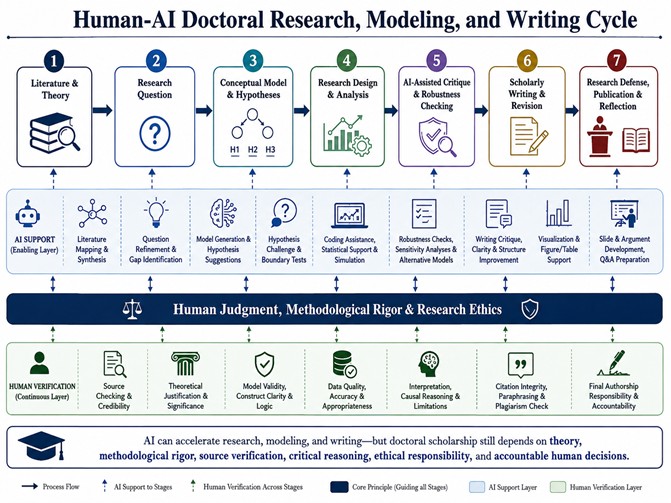
Doctoral research increasingly requires scholars to work across large bodies of literature, complex conceptual models, multiple analytical approaches, and demanding standards of academic writing. Asia University’s Department of Business Administration therefore integrates generative artificial intelligence throughout the required doctoral course Research Methods. The course keeps research methodology, theoretical reasoning, and scholarly judgment as its academic foundation, while using AI intensively as a research partner for literature exploration, research design, conceptual and statistical modeling, data-analysis support, manuscript development, critical review, and research communication. The objective is to prepare doctoral students to conduct rigorous research in an environment where AI can greatly accelerate research work, but where the researcher remains responsible for theory, evidence, methods, interpretation, and every final scholarly decision.
A major emphasis of the course is the use of AI in the research-development process. Students learn how to use generative AI to explore broad research areas, compare definitions, map theoretical perspectives, identify possible research gaps, and develop alternative research questions. AI can help summarize patterns across a body of literature, suggest competing explanations, or generate possible extensions of an established theory. However, students are trained to treat these outputs as starting points rather than academic evidence. They must return to original journal articles, verify claims and citations, determine whether the proposed gap actually exists, and decide whether a research question makes a meaningful theoretical contribution. This distinction between AI-assisted exploration and researcher-verified scholarship is reinforced throughout the course.
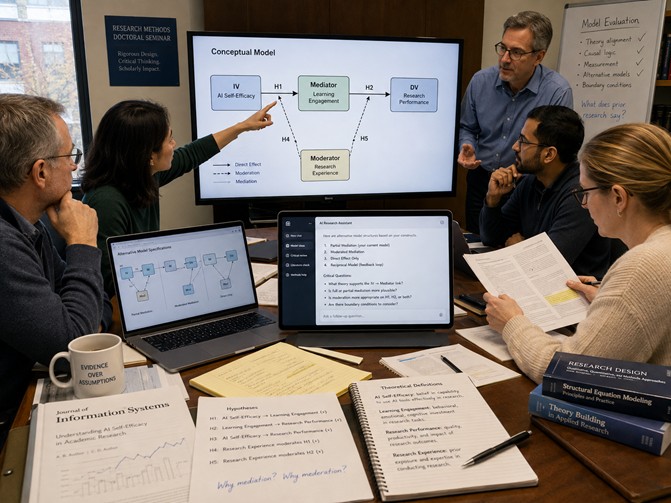
The course places especially strong emphasis on AI-supported research modeling. Doctoral students use AI to translate theoretical arguments into candidate conceptual models, compare alternative causal structures, identify possible mediators, moderators, controls, and boundary conditions, and examine whether hypotheses are logically consistent with the proposed theory. Students may ask AI to challenge a model, identify omitted relationships, propose rival explanations, or explain why two constructs may be conceptually redundant. They then evaluate these suggestions using theory and prior research. For quantitative studies, AI can also support the development and interpretation of regression, mediation, moderation, path, or structural-equation models by helping students organize variables, debug analytical logic or syntax, compare alternative specifications, and interpret statistical output in plain language. The course makes clear that an attractive model is not necessarily a valid model: students must justify every path theoretically, assess measurement quality, evaluate assumptions, examine robustness, and avoid causal claims that the design cannot support.
AI is also integrated into research design and methodological decision making. Students use AI to compare qualitative, quantitative, mixed-method, experimental, survey, case-study, and secondary-data approaches; critique sampling plans; identify threats to validity; refine questionnaire or interview wording; and generate possible robustness or sensitivity checks. In qualitative work, AI can assist with preliminary coding, theme organization, case comparison, and alternative interpretations. In quantitative work, AI can help explain procedures, suggest diagnostic checks, organize analytical workflows, and identify inconsistencies between hypotheses, models, and reported results. Students are expected to verify all AI-supported decisions against methodological standards and the actual data rather than accepting automated recommendations.
A second defining feature is the systematic use of generative AI in scholarly writing. Students use AI to move from research notes to structured outlines, improve the logical flow of theoretical arguments, compare alternative ways to present hypotheses, clarify methods, strengthen transitions between results and discussion, and adapt technical explanations for different academic audiences. AI is also used as a reviewer-style critique tool: students can ask it to identify unclear logic, unsupported claims, repetitive sections, missing limitations, inconsistent terminology, or places where the manuscript overstates the evidence. For titles, abstracts, introductions, literature reviews, methodology sections, results, discussions, and conclusions, students learn to use AI iteratively—draft, critique, verify, revise—rather than simply asking AI to produce a finished paper. Special attention is given to avoiding fabricated references, checking every citation against the original source, preserving the author’s scholarly voice, and ensuring that AI-assisted writing accurately represents the research actually conducted.
The course also connects modeling and writing. Students learn that a strong research paper must maintain consistency among the research question, theory, conceptual model, hypotheses, methods, statistical model, results, and conclusions. AI can be used to audit this chain for contradictions—for example, whether a mediator discussed in the theory is actually tested, whether a moderation claim matches the estimated interaction, whether the discussion overstates a nonsignificant relationship, or whether the abstract reports the same model and findings as the main text. This use of AI as a consistency checker is particularly valuable in doctoral work, where complex models and long manuscripts can easily develop internal inconsistencies.
Research ethics and human accountability are embedded throughout the course. Students discuss transparency in AI use, confidentiality of research data, bias, hallucination, authorship responsibility, source integrity, reproducibility, and the limits of automated interpretation. AI output is never treated as an authority. Students are expected to compare prompts, test alternative explanations, document important AI contributions when appropriate, and explain why they accepted, modified, or rejected AI-generated suggestions.
The course culminates in a doctoral-level research proposal or research paper in which students develop a theoretically grounded question, construct and defend an appropriate model, justify the methodology, analyze or plan the analysis, and communicate the study in publication-oriented academic writing. AI may support every stage, from literature exploration and model critique to analysis assistance and manuscript revision, but the final product must demonstrate independent scholarly judgment. Through this approach, the course prepares doctoral students not merely to use AI, but to direct it intelligently—using AI to increase the speed, breadth, and quality of research while preserving the rigor, originality, and accountability expected of doctoral scholarship.